Seesa
Seesa for accountancy practices

Every deadline. Every client. One mind.

Seesa reads everything the practice already has — every email, document and message about every client — and adds four workflows that run the recurring work: statutory deadlines, the records you're chasing, the fees you're owed, and the review pack that pulls all three together. It watches, sorts and drafts. Your people decide, and your people file.

See the four workflows
The line that doesn't move

Seesa does not file.

It tells you what's due, chases the client for what's missing, and writes the message. A person submits to Companies House and HMRC — every time, on purpose. A wrongly-filed return is worse than a late one, so that decision never leaves the practice.
The work isn't hard. Remembering all of it is.

Forty clients, each with a year end on a different date, each pulling four or five statutory clocks behind it. Half of them owe you documents. Some of them owe you money. One of them is waiting for a call you promised on Tuesday. None of it is difficult; all of it has to happen on time, and every piece of it lives in a different inbox.

Seesa already holds all of those inboxes in one memory. This plug-in teaches it the shapes a practice works in — clients, obligations, records, invoices — so it can run the clocks, chase what's outstanding and write the next message itself. Your people read it, change it and approve it. The routine runs; the judgement, and the filing, stay yours.

Four workflows. One memory. Nothing sent, and nothing filed, without you.

Each one watches a trigger, does the reading and sorting, and drafts the next action for a person to approve.

The filing calendar

It watches
Every client obligation on its own clock — annual accounts, the corporation tax return and the payment that falls due before it, confirmation statements, each VAT quarter, self assessment, the payroll year end.
It does
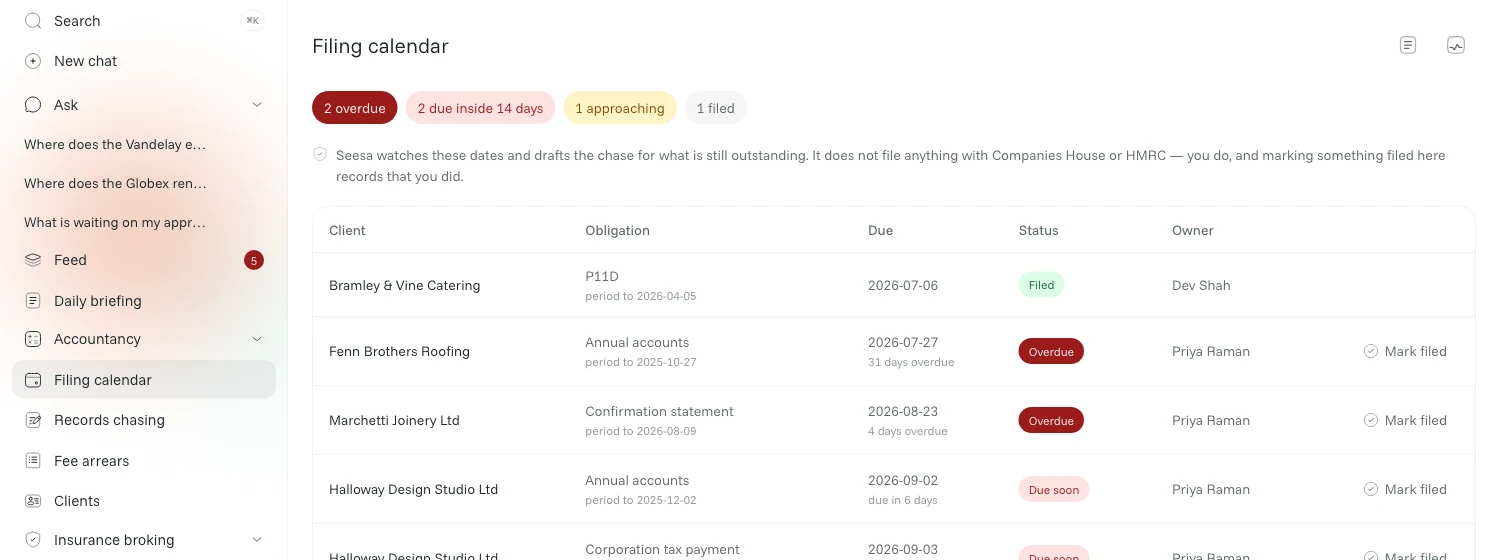
Puts the whole practice on one calendar, ordered by what's closest, and drafts the chase for whatever is still outstanding as each deadline approaches.
You decide
Seesa never files anything. You do, and marking it filed records that you did.
The filing calendar: two overdue filings at the top, then a set of accounts and its corporation tax payment a day apart, each with the period they cover.
Nine clocks, each with its own arithmetic
  • Annual accounts — nine months after the year end
  • Corporation tax payment — nine months and a day
  • The CT600 itself — twelve months
  • VAT — one month and seven days after the quarter
  • Confirmation statement — fourteen days
  • Self assessment — 31 January, whichever year it falls in

A quarter ending 30 June is due 7 August, not 6 August. Month ends move to month ends.

Chasing records

It watches
Everything you're waiting on from a client — bank statements, receipts, a payroll figure, an answer to one question that's holding up a set of accounts.
It does
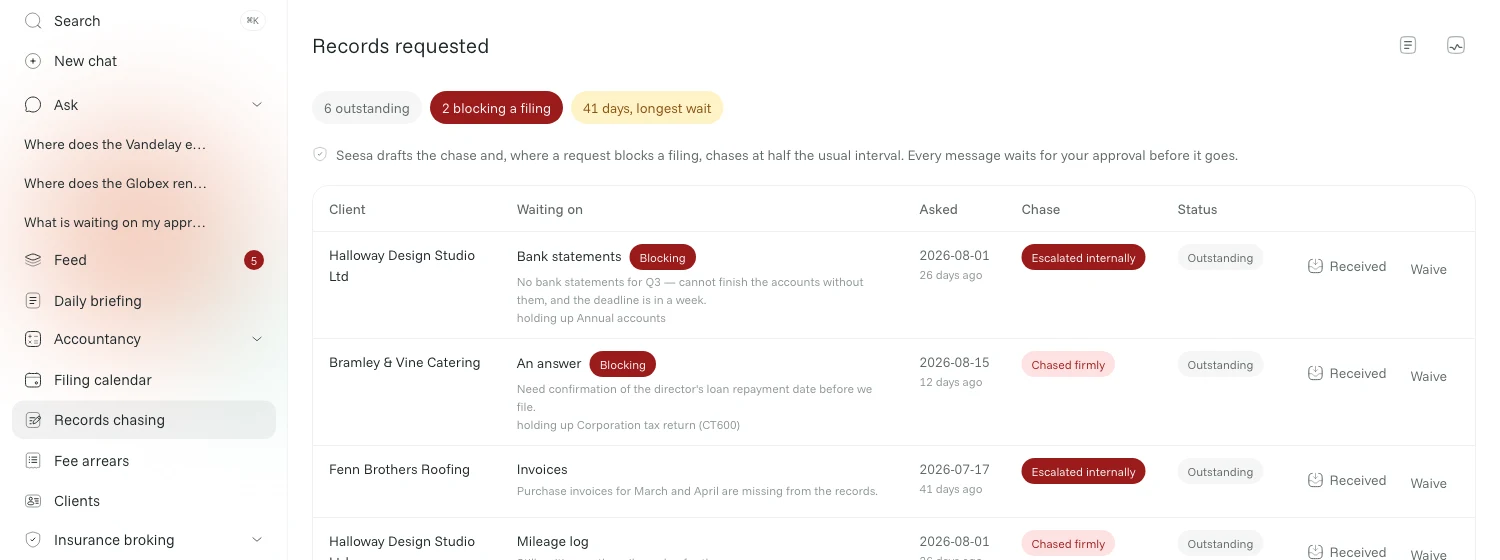
Reads what was asked for, works out whether it's blocking work, and walks each request up a ladder. Anything that blocks a filing is chased at twice the rate of anything that doesn't.
You decide
Every chase is drafted and waits for you. You can waive a request outright.
Records requested: what each client still owes, with anything blocking a filing badged and chased twice as often.
The ladder, and the twist
  • First ask — 3 days
  • Follow up — 10 days
  • Firmer ask — 21 days
  • To the person who owns the client — 35 days

A blocking request runs at half those intervals. A client sitting on bank statements in January is not the same problem as one sitting on a mileage log in June.

Fee arrears

It watches
Every unpaid invoice, and how long it's been unpaid.
It does
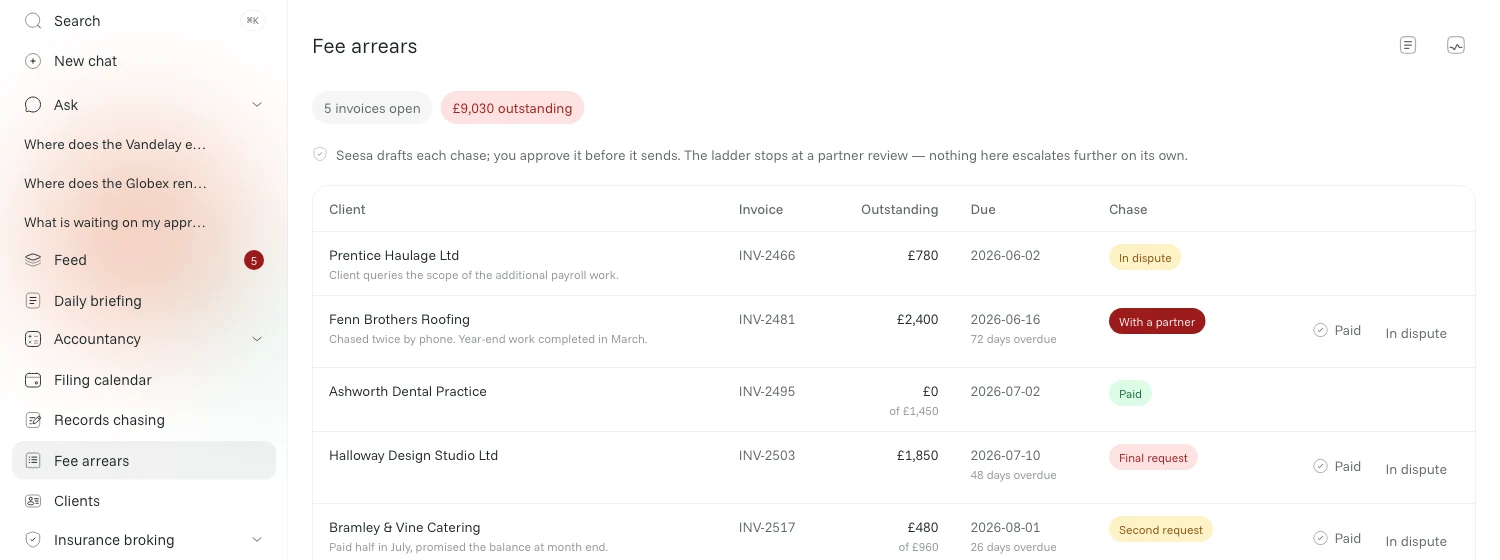
Walks each one up a ladder that escalates in tone — a reminder, a second request, a firmer final request — and then stops, with a note to the partner who owns the relationship.
You decide
The ladder stops at a partner. Nothing escalates further on its own.
Fee arrears: unpaid invoices on the ladder, from a first reminder through to a partner review, with paid and disputed rows off it.
Deliberately gentler than debt collection
  • Reminder — 7 days
  • Second request — 21 days
  • Final request — 45 days
  • To the partner — 70 days, and it stops

You're chasing a client you want to keep. An invoice marked in dispute leaves the ladder immediately.

Client review packs

It watches
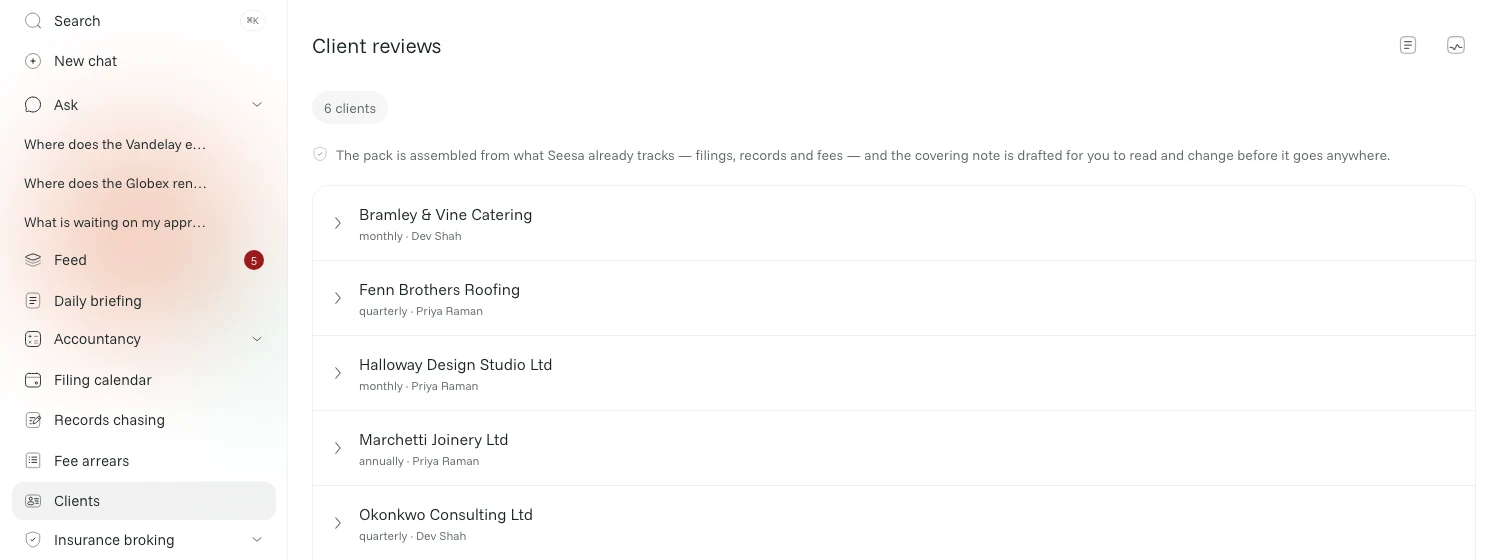
Each client on the review cadence you set — monthly, quarterly, annually.
It does
When one comes round, pulls together that client's upcoming filings, what you're still waiting on, and what's unpaid, and drafts the covering note from all three.
You decide
You read the pack and the note before the client does.
Client reviews: each client on its own cadence, with the review pack built from filings, records and fees when one comes round.
One pack, from everything the practice already knows
  • Filings due in the next ninety days, and anything overdue
  • Records outstanding, and which of them are holding up work
  • Fees unpaid, and how long
  • The prose the covering note is drafted from, shown before it's written

“Nothing to report” is a real answer, and it says so rather than producing an empty pack.

Ask anything

And because it's all one memory, you can just ask.

The workflows run on their own. Everything they know — and everything in your email, documents and messages — is there to be asked about, in plain language, with the sources shown.

  • Which clients have a filing deadline in the next thirty days that we haven't started?
  • What are we still waiting on from Marchetti Joinery, and how long have we been asking?
  • Which records are holding up an accounts filing right now?
  • Draft the covering note for the Okonkwo quarterly review.
  • Who owes us money past 45 days, and what have we already sent them?
  • What did this client's year end look like last time, and what went wrong?

Your records, not a new system

Import clients, year ends, obligations and unpaid invoices from what you already use — a CSV export today, a direct connection where one exists. Your practice software stays the record.

Approval on everything that leaves

Every chase, reminder and covering note is drafted and waits for a person. Filing, fee escalation beyond a partner, and anything that needs a sign-off are never automatic.

Hosted, or on-prem

Your clients' financial affairs can stay in your building. The whole of Seesa runs in our cloud or on hardware you own. Local AI with Seesa →

Questions

No. It reads from it. Import your client list and their year ends — a CSV export today, a direct connection where one exists — and Seesa holds the same clients, obligations and invoices in its memory alongside your email, documents and messages. Your system stays the record; Seesa does the watching, the reading and the drafting.