Seesa
Seesa for insurance brokers

The whole book, and everything anyone said about it.

Seesa reads everything the firm already has — every email, document and message about every client — and adds four workflows that run the recurring work: the renewal countdown, the claims desk, the Consumer Duty calendar and premium arrears. It watches, grades, sorts and drafts. Every regulated judgement stays with your people.

See the four workflows
Where it stops
  • It doesn't state cover, or advise

    No draft says what is covered, recommends a product, or assesses suitability. Those are your authorised people's, and the drafts are written so they stay that way.

  • It doesn't decide a claim

    Not accept, not decline, not reserve, not value. It acknowledges and it notifies. Where an outcome is recorded, a person decided it and their decision is what's saved.

  • It doesn't conclude fair value

    It tracks when each assessment is due and what evidence it needs. The conclusion is the firm's, recorded in the name of whoever reached it.
A broker's year is one long countdown, interrupted by claims.

Every policy renews on its own date, and the work starts sixty days before it. In between, claims arrive in whatever words the client happened to use — and the difference between a cracked windscreen and a warehouse fire has to be spotted in minutes, not on Monday. Meanwhile forty products each need an annual assessment, and somebody has to be able to show it was done.

Seesa already holds every email, document and message about every client in one memory. This plug-in teaches it the shapes a broker works in — policies, claims, products, premiums — so it can run the countdowns, grade what arrives, and write the first draft. What it will not do is any of the regulated part, and it is built so that it can't.

Four workflows. One memory. Every judgement yours.

Each one watches a trigger, does the reading and grading, and drafts the next action for a person to approve.

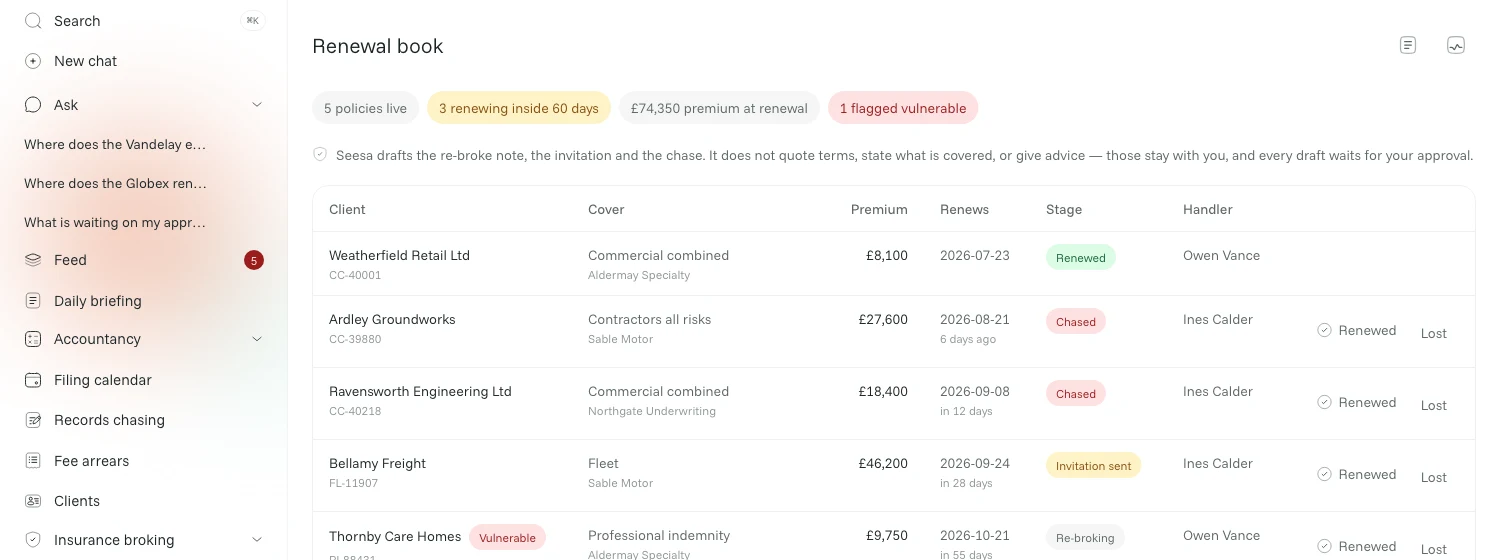
The renewal book

It watches
Every policy, counted down to its renewal date.
It does
Opens the re-broke at sixty days, drafts the invitation at thirty, and chases at fourteen. A policy imported inside a window is picked up once, at the tightest rung it has already passed — not once for every window it went through.
You decide
You set the terms and give the advice. It writes the letters.
The renewal book: every policy counted down to its date, with the re-broke, invitation and chase rungs it has reached.
Three rungs, and one of them isn't a client message
  • 60 days — start re-broking. Internal: it's a market exercise, not a letter to the client.
  • 30 days — the renewal invitation is drafted.
  • 14 days — the chase, if nothing has come back.
  • Past the date — it stays at the tightest rung rather than dropping off the book.

The two client rungs are drafted without quoting terms and without giving advice. Those aren't things software should be doing on a broker's behalf.

The claims desk

It watches
Claims as they're reported, in whatever words the client used.
It does
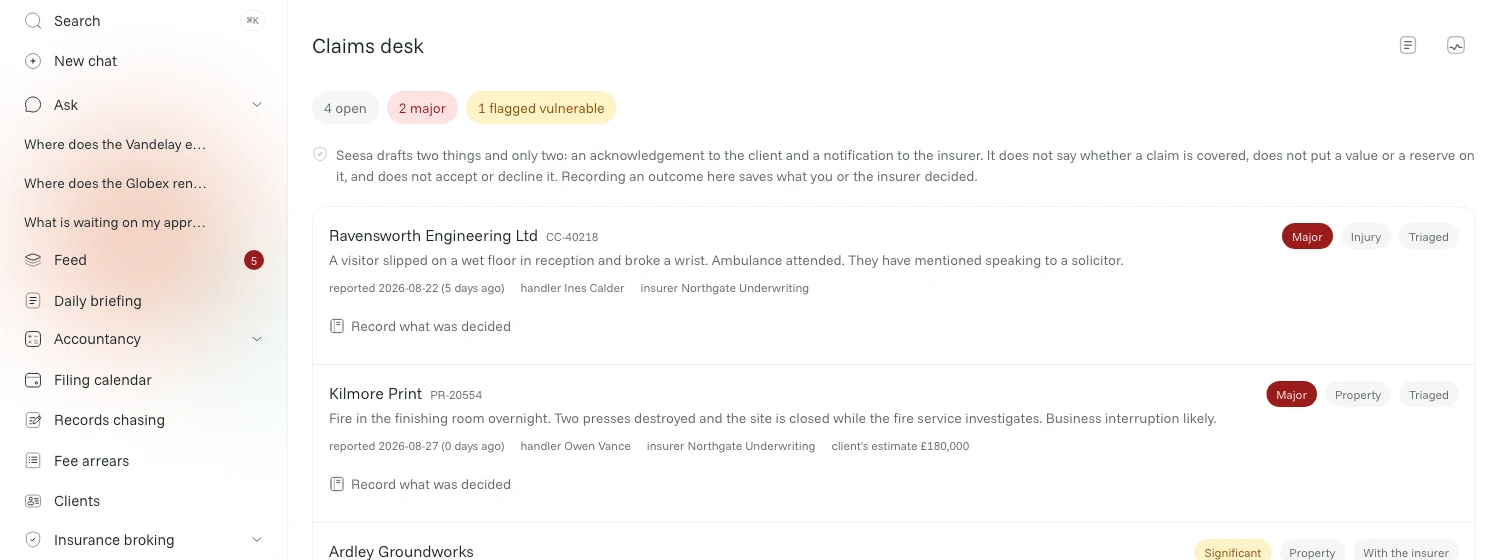
Reads the report, grades it, works out what class of claim it is, matches the handler and insurer from the renewal book, and drafts two things: the acknowledgement to the client and the notification to the insurer.
You decide
Nothing else. It does not say whether the claim is covered, does not put a value or a reserve on it, and does not accept or decline it.
The claims desk: a fire and an injury graded major and pushed to the top, each routed to its handler and insurer, in the client's own words.
It grades up, never down
  • A fire, a serious injury, an ambulance, a site closed — major, straight to the top of the desk.
  • An injury, a theft, a third party, a solicitor's letter — significant.
  • A reversed van and a cracked windscreen — routine.

Over-grading a claim costs a broker a minute of attention. Under-grading one can miss a same-day notification duty, so the reading always errs upward.

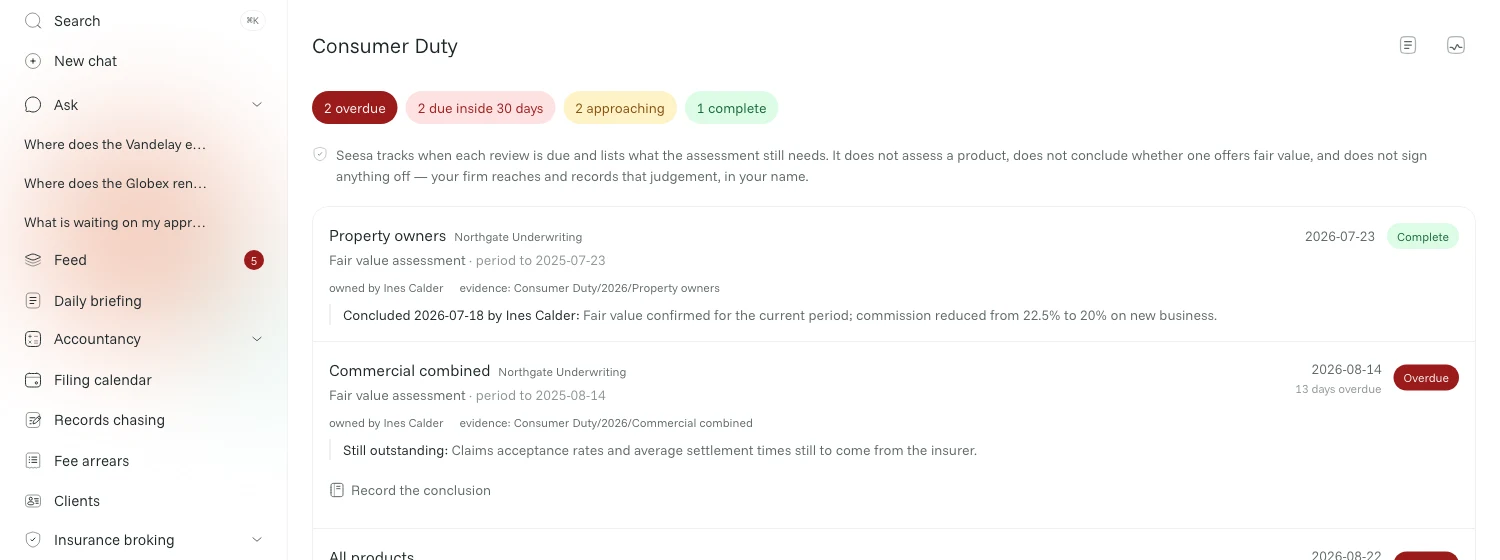
Fair value and Consumer Duty

It watches
Each product's assessment cycle — the fair value assessment, the target market review, the vulnerable customer policy, quarterly MI, the board report.
It does
Tracks when each one falls due, from ninety days out, and lists the evidence the assessment still needs so it's to hand when you sit down to do it.
You decide
It never assesses the product. Recording a conclusion requires the name of the person who reached it.
The Consumer Duty calendar: every product's assessment on its own clock, with the evidence each one still needs.
What's expensive isn't the judgement
  • It's remembering which of forty products is due this month.
  • It's finding the claims data, the commission disclosure sample and the MI when you need them.
  • It's being able to show, afterwards, that the work was done and who did it.

Seesa does the first two. The third is why a conclusion won't save without a name against it — a conclusion nobody signed isn't evidence of anything.

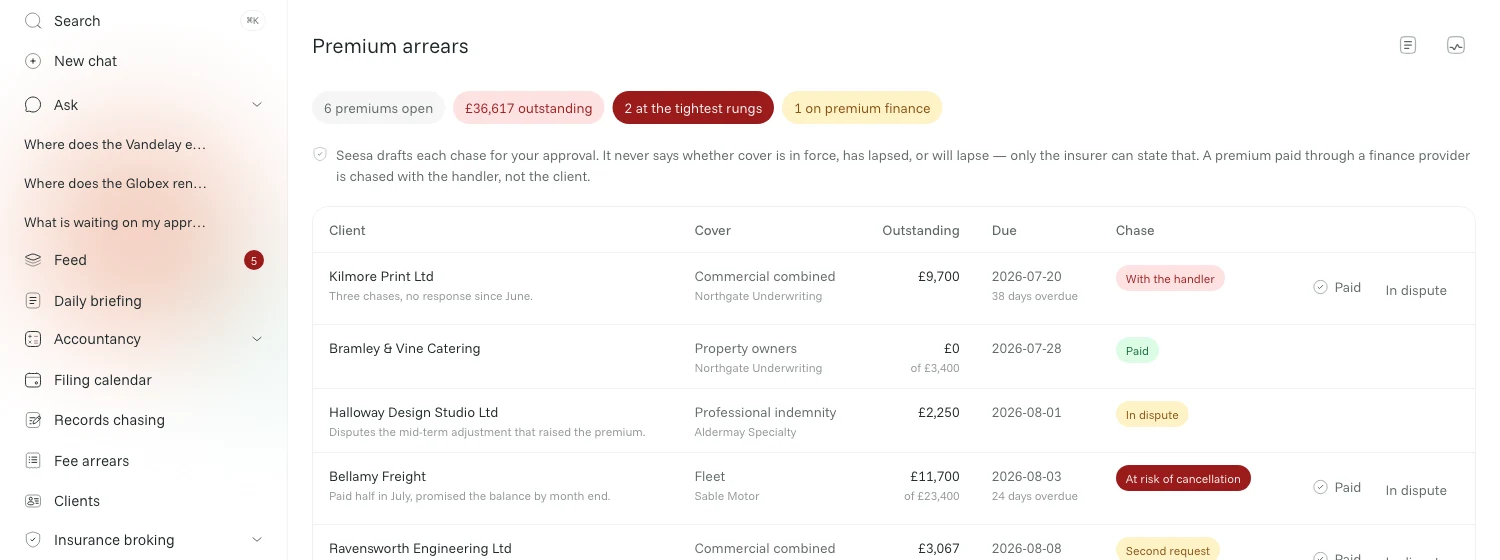
Premium arrears

It watches
Every premium past its due date, and how far past.
It does
Walks a tighter ladder than an ordinary invoice would get, because an unpaid premium has a consequence an unpaid invoice doesn't.
You decide
It never says whether cover is in force, has lapsed, or will lapse on a date. Only the insurer can say that.
Premium arrears: the tighter ladder, with a premium on finance flagged and a vulnerable client marked for a person to handle.
Tighter rungs, and one thing it refuses to do
  • Reminder at 7 days, second request at 14.
  • At 21 days: the client is told the insurer may issue a cancellation notice, and asked to call their handler.
  • At 30: to the handler, and it stops.
  • A premium paid through a finance provider is that provider's arrears — so the note goes to the handler, and the client is never chased for it.

Telling a client they're uninsured when they aren't, or insured when they aren't, are both real harm. So no draft on any rung states the cover position.

Ask anything

And because it's all one memory, you can just ask.

The workflows run on their own. Everything they know — and everything in your email, documents and messages — is there to be asked about, in plain language, with the sources shown.

  • What's renewing in the next sixty days, and how much premium is in it?
  • Which claims came in this week that nobody has picked up?
  • Where are we with the Ravensworth claim, and what have we told the insurer?
  • Which fair value assessments are overdue, and what evidence is each one missing?
  • Who's more than three weeks behind on a premium, and which of those are on finance?
  • Show me every client flagged as vulnerable with something open right now.

Your book, not a new system

Import clients, policies, renewal dates and premiums from what you already use — a CSV export today, a direct connection where one exists. Your broking system stays the record.

Approval on everything that leaves

Every invitation, chase, acknowledgement and notification is drafted and waits for a person. The regulated acts — cover, advice, claim decisions, fair value conclusions — are not things the software does at all.

Hosted, or on-prem

Claims files and client records can stay in your building. The whole of Seesa runs in our cloud or on hardware you own. Local AI with Seesa →

Questions

No, and that isn't a gap we intend to close. Nothing Seesa drafts states what is covered, gives advice, or assesses suitability — those are regulated acts belonging to your authorised people. What it does is the work around them: the watching, the sorting, the chasing and the first draft.