Seesa
Seesa for property management

The whole portfolio, in one mind.

Seesa reads everything your company already has — every email, document, message and record about every building — and adds seven workflows that run a portfolio's routine: certificates, repairs, arrears, renewals, owner statements, inquiries and move-ins. It watches, sorts and drafts. Your team approves.
See the seven workflows
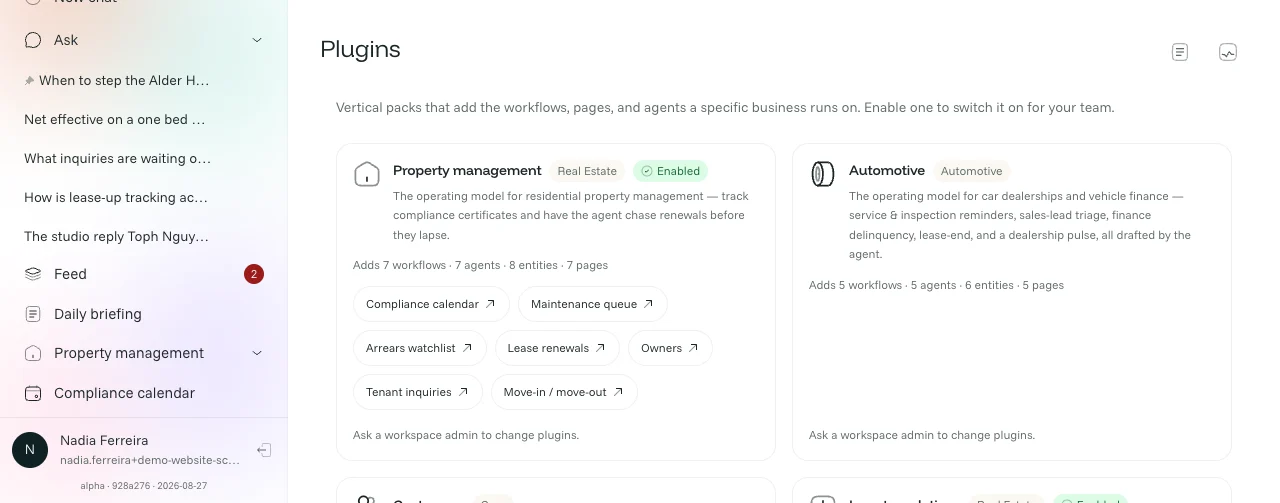
The Seesa plug-in directory with Property management enabled: seven workflows, seven pages, eight entities.

Property management is a hundred small deadlines and a thousand small messages.

A gas certificate expires. A resident reports a leak. Rent is three weeks late. A lease ends in ninety days. An owner wants their statement. A prospective tenant asks about the two-bed. None of it is hard; all of it has to happen on time, and every piece of it lives in a different inbox.

Seesa already holds all of those inboxes in one memory. The property plug-in teaches it the shapes — buildings, tenancies, certificates, jobs, owners — so it can watch the clocks, sort the arrivals and write the next message itself. Your team reads, adjusts and approves. The routine runs; the judgement stays human.

Seven workflows. One memory. Nothing sent without you.

Each one watches a trigger, does the reading and sorting, and drafts the next action for a person to approve. The screens are the real product, on a fictional portfolio.

Compliance calendar

It watches
Every certificate and inspection, per building, on its own clock — gas, electrical, energy, lifts, facade filings, whatever your jurisdiction requires.
It does
Shows you what's overdue, due soon and fine at a glance. As a deadline approaches, it drafts the chase to the contractor of record — before it lapses, not after.
You decide
You approve the chase before it's sent.
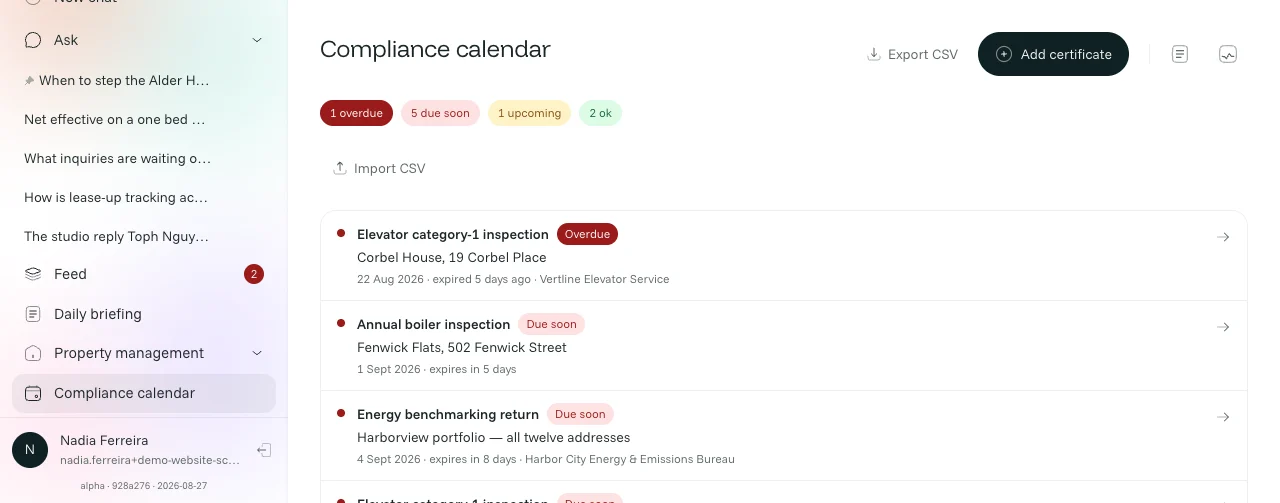
The compliance calendar: an overdue elevator inspection at Corbel House, two more due within days, each with its contractor.

Maintenance queue

It watches
Repair reports as they arrive — from residents, from your building department, from your own inspections.
It does
Classifies urgency (emergency, urgent, routine) and trade, matches the right contractor by trade and track record, and drafts the dispatch.
You decide
You approve the dispatch. Emergencies are flagged first.
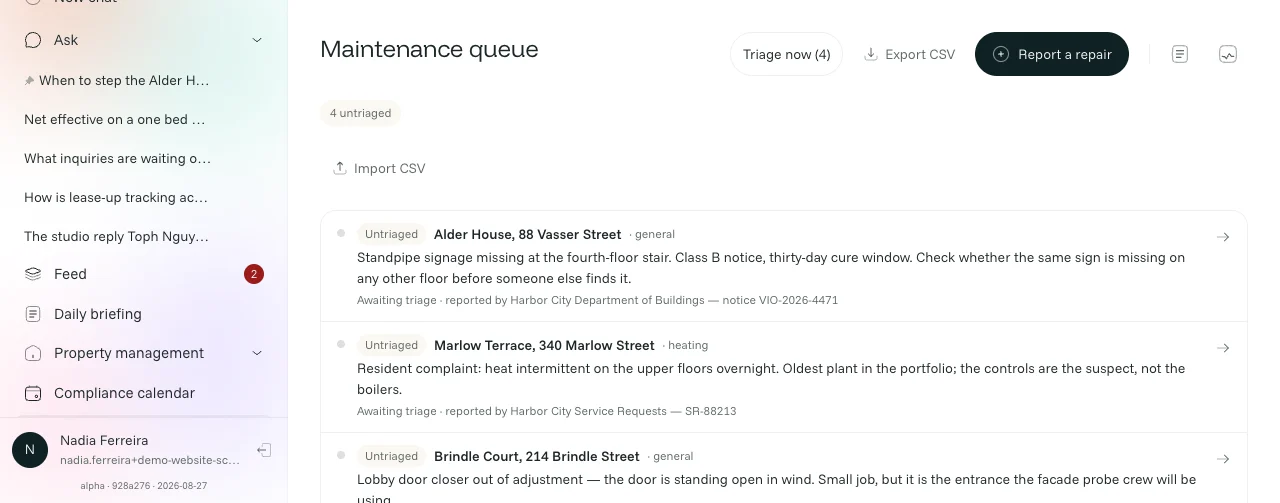
The maintenance queue: four untriaged reports including a heating complaint and a building-department notice, each awaiting triage.

Arrears watchlist

It watches
Every tenancy where rent hasn't arrived, and how long it's been.
It does
Walks each case up a ladder you set — reminder, first notice, second notice, flag to manager — and drafts the letter for each step in your voice.
You decide
Serving notice is never automatic. That decision stays with a person.
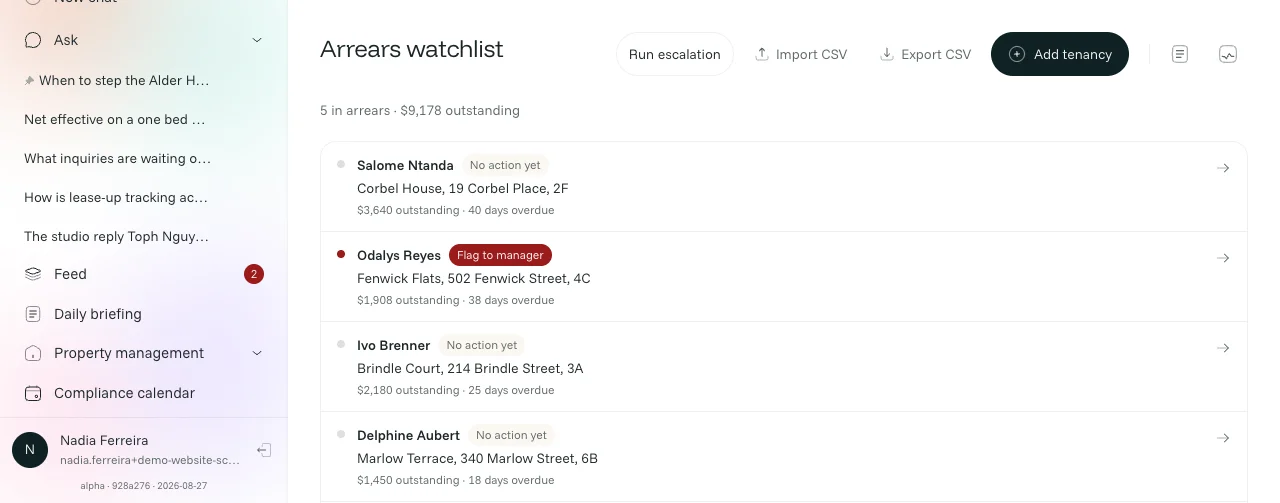
The arrears watchlist: five tenancies in arrears, one flagged to a manager after 38 days.

Lease renewals

It watches
Every lease end date, ninety days out.
It does
Flags at ninety days, drafts the renewal offer at sixty — with a recommended rent from market rate or your standard uplift — and chases at thirty.
You decide
You set the terms. It writes the letters.
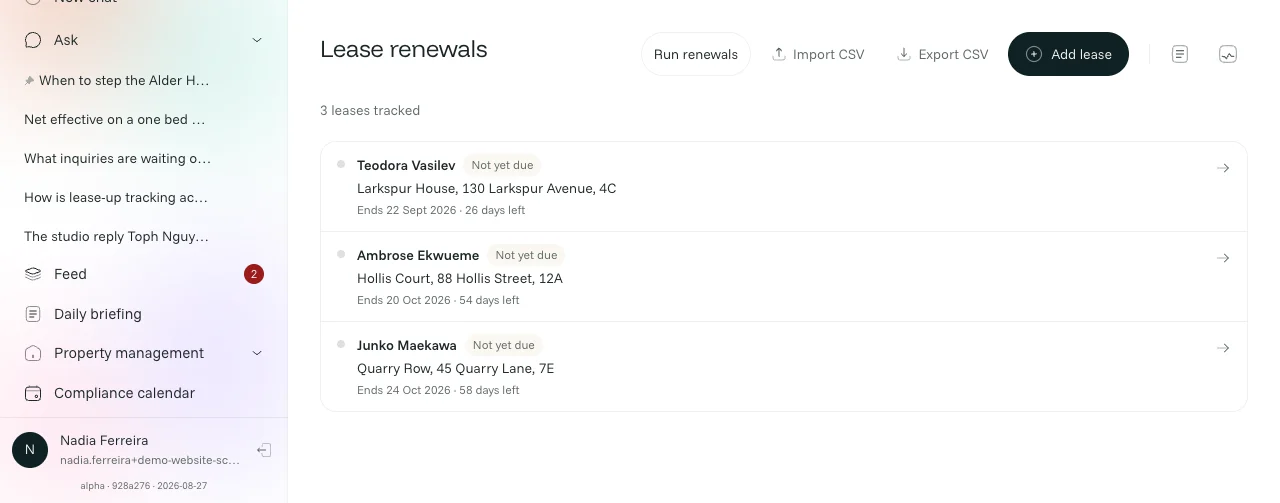
Lease renewals: tenancies approaching lease end, each at its stage — flagged, offer sent, chased.

Owner reporting

It watches
Each owner's portfolio, on the reporting cadence you agree with them.
It does
Pulls together that owner's arrears, open repairs, compliance position and upcoming renewals across their buildings, and drafts the statement.
You decide
You read it before the owner does.
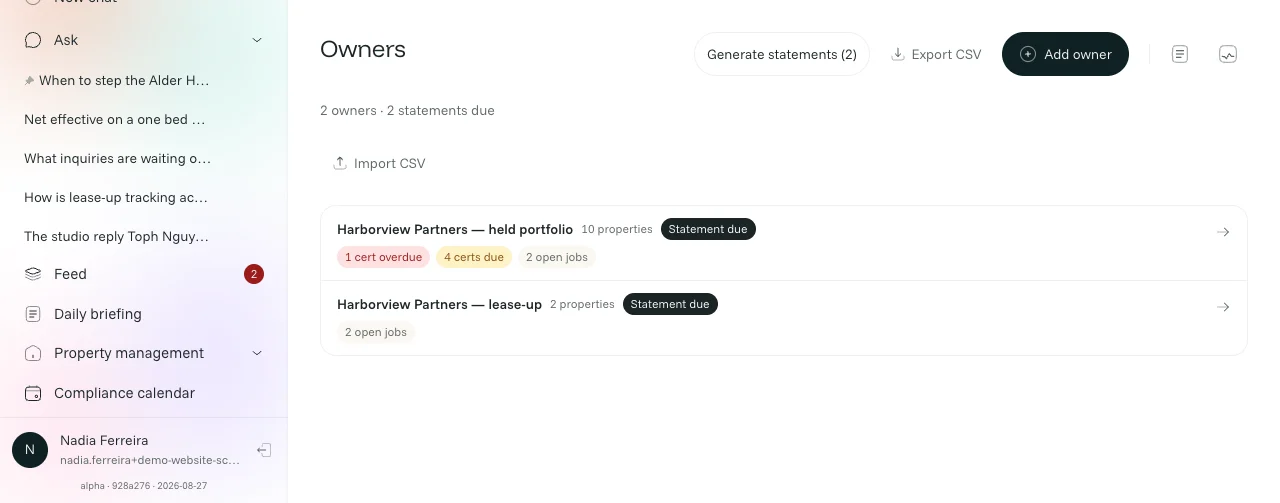
Owners: each owner's buildings and the date their next statement is due.

Tenant inquiries

It watches
Every inbound inquiry about a unit — viewings, pricing, availability, the general question.
It does
Sorts them, reads what the person actually asked, and drafts the reply with the right details for that unit.
You decide
You approve the reply. Nothing goes out unread.
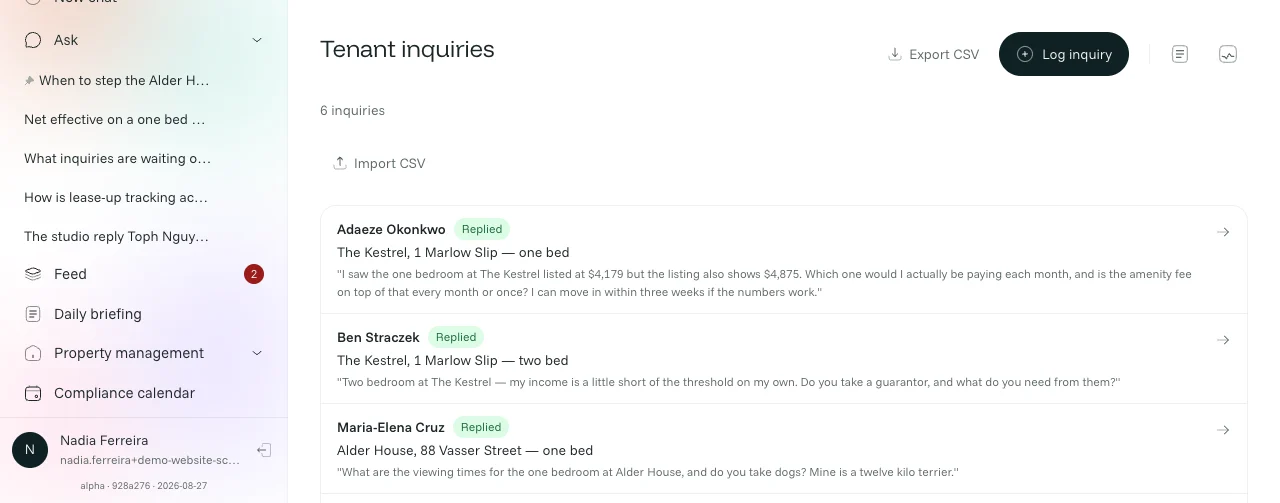
Tenant inquiries: six inquiries about specific units, quoting what each prospective tenant actually asked.

Move-in and move-out

It watches
Every tenancy that's starting or ending.
It does
Runs the checklist — welcome pack, inspection, deposit on the way in; checkout, deductions, return on the way out — and drafts each step's message when it's due.
You decide
Deductions are proposed, not decided.
Move-in
  1. Welcome pack drafted and sent
  2. Inspection scheduled and recorded
  3. Deposit confirmed and protected
Move-out
  1. Checkout inspection
  2. Deductions proposed, with the evidence
  3. Return processed on approval
Ask anything

And because it's all one memory, you can just ask.

The workflows run on their own. Everything they know — and everything in your email, documents and messages — is there to be asked about, in plain language, with the sources shown.

  • Which certificates lapse in the next sixty days, across the whole portfolio?
  • Who's more than thirty days in arrears at Corbel House, and where are we with each?
  • What did the resident at 340 Marlow Street report last week, and has anyone been out?
  • Draft the renewal offer for 4C at Fenwick Flats at the market rate.
  • What's open on the Whitfield portfolio before their statement goes out on Friday?
  • Which contractors have we used for boiler work this year, and how did each go?

Your records, not a new system

Import buildings, tenancies, certificates and contractors from your existing system — a CSV export today, a direct connection where one exists. Your system stays the record.

Approval on everything that leaves

Chases, notices, offers, dispatches and statements are drafted and wait for a person. Serving notice, agreeing terms and deciding deductions are never automatic.

Hosted, or on-prem

The whole of Seesa, including this plug-in, runs in our cloud or on hardware you own in your own building. Local AI with Seesa →

Questions

No. It reads from it. Import from your system of record — a CSV export today, a direct connection where one exists — and Seesa holds the same buildings, tenancies and certificates in its memory alongside your email, documents and messages. Your system stays the record; Seesa does the watching, the reading and the drafting.